What Tools Do You Need to Start an Online Business? (2026 Beginner Guide)
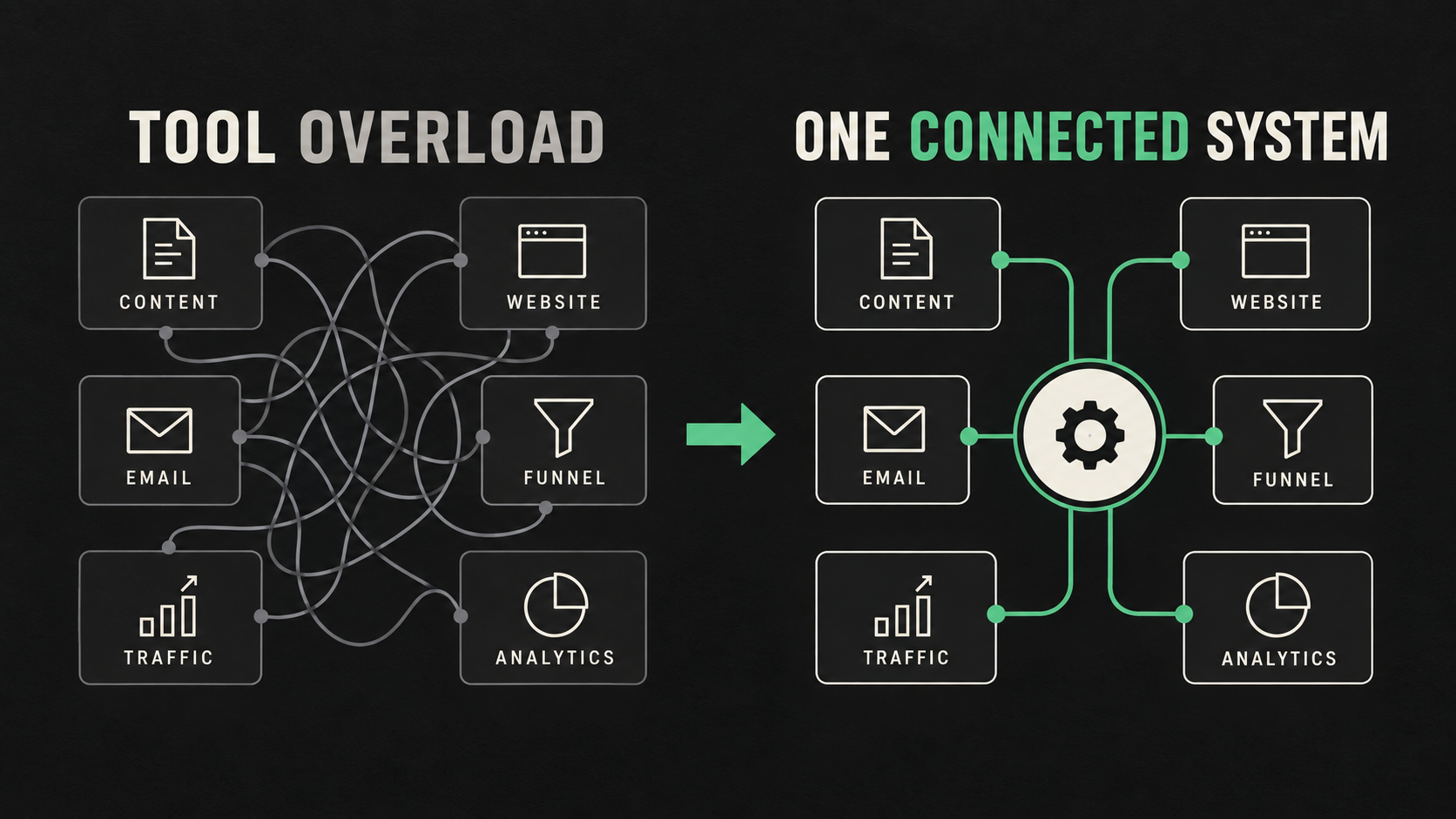
If you are asking what tools you need to start an online business, the short answer is: fewer than the software market suggests. Most beginners need five connected capabilities—a way to create useful content, an owned destination, a method for capturing and following up with interested people, a clear offer path, and basic measurement. You do not need the largest possible tool stack. You need the smallest system you can understand, operate, and improve.
The difficult part is rarely finding software. It is connecting the pieces into a customer journey that makes sense. If you are still deciding what kind of business to build, begin with this practical guide to starting an online business. This article focuses on the tools and infrastructure that support that business.
What tools do I need to start an online business?
A practical beginner stack has five parts:
- Content and traffic: a way to get discovered by the right people.
- Website or owned destination: a place where you control the message and next step.
- Email and follow-up: a permission-based way to continue the relationship.
- Funnel and offer: a clear path from interest to a relevant product, service, or recommendation.
- Analytics and measurement: enough data to see where the journey works or breaks.
Those functions can be supplied by five separate products, by one all-in-one online business platform, or by a mixture of both. The correct choice depends on cost, ownership, portability, learning curve, and the work you can realistically sustain. Before buying a bundled system or a separate stack, apply this checklist for deciding whether an online business opportunity is legitimate.
For a hands-on example, see the HighLevel review, which documents how one all-in-one platform is being configured for a real productized service.
The real beginner problem is tool overload
The software market is not short of options. The 2026 Marketing Technology Landscape counted 15,505 products. That was only 0.79% growth from the previous year, but the apparently flat total hid substantial churn: 1,488 products were added while 1,367 were removed. The practical lesson is not that a solo beginner should compare thousands of products. It is that new tools appear, disappear, and overlap constantly.
Data source and caveat: these figures come from the 2026 Marketing Technology Landscape. Its catalog covers the broad marketing-technology market, including enterprise software. It describes the scale and churn of the category; it does not tell a beginner how many tools they personally need.
Gartner’s 2025 marketing-technology research reported that organizations used about 49% of the capabilities available in their martech stacks. That is an enterprise-oriented measure, not a benchmark for a one-person online business, but it illustrates the same risk: paying for capability is not the same as putting it to useful work.
Data caveat: tool-utilization studies typically examine marketing teams and measure available platform capability. They should not be interpreted as a prediction of a beginner’s results, costs, or productivity.
A longer subscription list can create more logins, integrations, updates, billing dates, and failure points without creating more customers. The goal is not to own fewer tools for its own sake. The goal is to remove tools that do not perform a necessary job in the customer journey.
The five-part online business tool stack
1. Content and traffic tools
Every online business needs a way to reach people. That could be search-focused articles, short-form video, long-form video, social posts, email outreach, partnerships, communities, or paid advertising. A beginner does not need to use every channel.
Choose one primary traffic engine that fits the audience and a format you can produce consistently. Your tool may be as simple as a phone camera, a writing editor, or a design application. What matters is whether the content reaches the right people and gives them a relevant next step.
Adding channels too early makes measurement harder. If five platforms send a small amount of mixed traffic into several unrelated offers, you may not know which message, audience, or source created the result.
2. A website or another owned destination
A website gives you control over your explanation, internal links, disclosures, and conversion path. It can also build a searchable library of useful content over time. For a content-led business, a domain and website are usually valuable even when they are not required on day one.
Your owned destination could begin as one focused landing page. It should answer three questions quickly:
- Who is this for?
- What problem does it address?
- What should the reader do next?
Websites do not generate traffic merely because they exist. Hosting, a theme, and a domain are infrastructure. The business still needs useful content, distribution, an offer, and measurement.
3. Email capture and follow-up
An email platform can collect permission-based leads and continue a conversation after the first visit. A basic system needs a form, a clear reason to subscribe, confirmation and unsubscribe handling, and useful follow-up.
Do not treat an opt-in as a sale. A useful measurement sequence is:
Traffic → Opt-in → Confirmed lead → Engagement → Click → Conversion
Each step diagnoses something different. A page can attract clicks but fail to collect leads. An email list can grow while engagement falls. People can click an offer without purchasing. The Journey From Click to Opportunity explains why clicks, opt-ins, confirmed leads, engagement, and conversions should be measured separately.
4. Funnel and offer tools
A funnel is simply the path a person follows from first contact to the next decision. It can be technically simple:
Useful content → focused page → email follow-up → relevant offer
The software matters less than the logic. One page should have one main purpose. The offer should solve the problem discussed in the content. The next step should not suddenly redirect the reader into an unrelated product.
If you sell your own product, you may also need checkout, payment processing, delivery, and customer support. If you use affiliate marketing, the vendor often handles the transaction and delivery, but you remain responsible for accurate claims, clear disclosures, and sending people to an offer that fits the content.
5. Analytics and business measurement
Beginners do not need an enterprise analytics suite. They do need enough information to answer practical questions:
- How many people saw the content?
- How many visited the page?
- How many became confirmed leads?
- How many engaged or clicked?
- How many purchased?
- What did the system cost?
- What revenue, profit, and margin remained after attributable costs?
Revenue alone is not enough. A system that produces $500 in revenue after $700 in advertising and software costs has not produced a $500 profit. Sample size also matters: one conversion from ten visitors does not establish a durable 10% conversion rate.
Visible Margin evaluates platforms across startup cost, beginner fit, time, profit potential, scalability, ownership, and risk. The full How We Score methodology explains why a long feature list cannot answer the whole business question.
What is the minimum viable tool stack?
A minimum viable stack is the smallest setup that can complete and measure one real customer journey. For a beginner building a content-led affiliate business, it might look like this:
| Business job | Minimum requirement | What can wait |
|---|---|---|
| Content | One repeatable format and publishing channel | Publishing everywhere |
| Website | One clear page or a simple content site | Complex design and dozens of pages |
| Permission-based capture and basic follow-up | Advanced segmentation and elaborate automation | |
| Offer path | One relevant offer and one clear next step | Multiple competing funnels |
| Measurement | Traffic, leads, clicks, conversions, revenue, and cost | Enterprise dashboards |
This is not a universal prescription. A freelancer may begin with a portfolio, contact form, calendar, and invoicing. An ecommerce business may need checkout, inventory, tax, shipping, and return systems from the beginning. The principle is the same: buy capability when the business process requires it.
Separate tools or an all-in-one online business platform?
There is no automatic winner. A separate tool stack can provide greater choice and portability. An all-in-one platform can reduce setup work and the number of integrations.
| Factor | Separate tools | All-in-one platform |
|---|---|---|
| Setup | More connections and decisions | Often faster when components are pre-connected |
| Flexibility | Choose a specialist for each job | Work within one provider’s feature set |
| Billing | Several subscriptions and renewal dates | Potentially fewer bills, but one larger dependency |
| Ownership | Assets may be easier to separate or move | Portability depends on the provider |
| Learning curve | Learn several interfaces | Learn one ecosystem |
| Failure risk | One tool can fail without removing everything | One account or platform change can affect more of the system |
The correct comparison is not the sticker price of one product against another. Compare the total cost of the full job, the time required to connect it, the features you will actually use, and what happens if you leave.
Where Wealthy Affiliate fits
Wealthy Affiliate is one example of integrated infrastructure for a content-led affiliate business. It combines training, WordPress hosting, market research, AI-assisted content tools, and community support. A free entry level can reduce the initial commitment for someone who wants to inspect the environment before upgrading.
That convenience should not be confused with a finished business. Having hosting, research, training, and publishing tools does not create demand or guarantee sales. My Wealthy Affiliate evidence page separates the platform’s features from the still-unproven question of profitability. Both links stay inside Visible Margin so readers can review the evidence and disclosures before visiting an affiliate offer.
What my HBA experience taught me about usability
I joined Home Business Academy (HBA) to inspect its connected training and marketing tools, then cancelled my subscription. In my own use, audio stopped and the app restarted when I switched to other apps; pausing video training also led to restarts. Finding the lesson and starting again created friction that I could not justify at the $128 monthly price I was paying.
I valued the owners’ marketing knowledge, the training, Traffic Maestro’s social-content scripts, and the video generator with teleprompter and light editing. Those benefits did not outweigh the recurring cost and playback problems for me. This is my firsthand experience, not a claim that every member encounters the same problems or that the system cannot work for someone else.
The practical lesson is to evaluate reliability during the tasks you actually perform, alongside features and price. A connected system still needs to be usable enough to operate consistently. My subscription is cancelled; HBA is not my current campaign.
Read the Home Business Academy review for the full context and evidence limits.
Can I start an online business for free?
You can begin learning, validating an audience, publishing content, and testing an idea with free tools. Social accounts, free design tools, free website plans, trial software, and some free platform tiers can reduce the initial cash cost.
Free does not mean costless. You still invest time, and free plans may limit domains, data export, automation, support, storage, or commercial use. If the idea gains traction, common early paid costs include a domain, hosting or a platform subscription, email software, and payment fees.
How much does it cost to start an online business?
There is no single honest number because the model changes the cost. A service business using an existing computer can start with very little cash. A content-led site may initially need only a domain and hosting or one platform subscription. Ecommerce may require products, samples, inventory, payment processing, shipping, and returns.
A better calculation is:
Startup cost + recurring software + traffic cost + transaction cost + delivery cost + the value of your time
Before paying, list the monthly and annual renewal amounts. Separate optional convenience from essential infrastructure. If a $50 monthly subscription saves little time and produces no measurable improvement, its annual cost is $600 before any other expense. Cost should be judged against actual use and business outcomes, not the length of the feature list.
People also ask about online business tools
Do I need a website to start an online business?
No. A freelancer can find a first client through a marketplace, referral, or social platform, and a creator can test demand before building a site. However, an owned website becomes increasingly useful for control, search visibility, disclosures, content organization, and a stable destination that is not tied entirely to one social platform.
What equipment do I need to start an online business?
For many service, content, or affiliate businesses, a reliable computer or smartphone and internet connection are enough to begin. Add equipment only when the work requires it—for example, a microphone for frequent audio, lighting for product demonstrations, or secure backup storage for client files.
What is the best online business platform for beginners?
The best platform is the one that supports your chosen model without adding unnecessary cost or complexity. Evaluate the complete job: website, content, email, checkout or affiliate path, analytics, support, portability, and recurring price. A platform can be beginner-friendly and still be the wrong economic choice for a specific person.
How do I simplify an online business?
Choose one audience, one important problem, one primary traffic engine, one clear next step, and one main offer. Track the journey before adding more channels or software. Remove a tool when you cannot explain the necessary business job it performs.
Is an all-in-one platform cheaper than separate tools?
Sometimes, but not automatically. Compare the all-in-one subscription with the total cost of the separate features you would genuinely use. Include setup time, integration maintenance, data portability, optional add-ons, and the cost of switching later.
A practical decision checklist
Before adding a tool, ask:
- Which necessary business job will this tool perform?
- Do I already own a tool that performs that job?
- Will I use the new capability this month?
- What is the true monthly and annual cost?
- Can I export my content, contacts, and data?
- What happens to the business if the tool closes or my account ends?
- Which metric should improve if the tool works?
If you cannot answer the first and last questions, the purchase is probably premature.
Build the system before expanding the stack
The essential online business tool stack is not a shopping list. It is a connected operating system:
Content → Owned destination → Permission-based follow-up → Relevant offer → Measurement
Start with one workable version. Confirm that every tool has a job. Measure clicks, confirmed leads, engagement, conversions, revenue, costs, and margin separately. Then improve the weakest stage.
Before replacing that stack with another program, ask whether you have tested the current system long enough to make a rational decision.
More software can be useful when real demand creates a real constraint. Until then, clarity is usually more valuable than capability you are not using.
Editorial and data note: software catalogs, platform features, prices, and research figures can change. The external market figures above provide context, not a prediction of individual results. Platform-specific observations are separated from claims about business outcomes, and no tool or training program guarantees traffic, leads, sales, profit, or income.