The Journey From Click to Opportunity
A practical look at what happens between attention, email confirmation, education, evaluation and a measurable business result.
Evidence note: Visible Margin tested the Inbox to Payday double opt-in and first email end to end. GetResponse is treated as the source of truth for confirmed email leads. This article explains the verified journey; it does not claim that the funnel is profitable.
See how Visible Margin separates researched, hands-on and live-tested evidence →
Most people meet an online income opportunity at the sales page.
But that is not where the journey begins.
Long before a product, platform or business model is presented, someone has already moved through a series of small decisions. A post caught their attention. A survey asked the right question. A recommendation felt relevant. They clicked, submitted an email address, confirmed it and decided whether the next message deserved their time.
That path matters.
If we only measure the final sale, we miss most of the system that created it. We also make it harder to tell the difference between genuine interest, accidental clicks and people who were never a good fit in the first place.
Visible Margin looks at what happens before and after the sales page.

Where the journey starts
There is no single starting point.
A person might arrive from a social post, a short video, a recommendation, a questionnaire or another source related to working from home and online business. The source changes the context. Someone actively searching for a specific platform is not in the same position as someone who has only expressed broad interest in earning online.
Both can be legitimate visitors. But they should not be counted or described as if they were identical.
The first useful question is therefore not, “How many leads did we get?”
It is, “Where did the interest come from, and what did that person reasonably expect next?”
Step 1: Attention creates a signal
A click is a signal, not a result.
It tells us that something earned enough attention for a person to take one action. It does not tell us that they understood the offer, wanted to buy anything or were ready to build a business.
That distinction is easy to lose when dashboards reduce people to traffic numbers.
At this stage, the job of the message is simple: make the next step clear and relevant. It should not rely on guaranteed-income language, invented urgency or a promise that the evidence cannot support.
Step 2: The opt-in turns interest into permission
An opt-in is stronger than a click because the visitor chooses to continue.
In the Inbox to Payday journey, the public entry point leads to a free beginner guide about building a simple online income system. The guide is based on a straightforward path:
Attention → Email → Offer
The purpose is not to throw another random opportunity at someone. It is to explain why an audience, an email relationship and a relevant offer need to work together.
An opt-in still is not the same as a confirmed lead. People mistype addresses, change their minds or submit without completing the next step. That is why the confirmation stage matters.
Step 3: Confirmation becomes a quality checkpoint
The email confirmation does two jobs.
First, it confirms that the address works and that the person can receive the guide and follow-up emails.
Second, it asks the person to make one more deliberate choice.
For this project, GetResponse is the source of truth for confirmed email leads. A form submission on its own is not counted as an active confirmed lead.
This gives us a cleaner measurement path:
traffic → opt-ins → confirmed leads
If 100 people visit, 20 submit and 12 confirm, those are three different numbers with three different meanings. Combining them into one “lead” total would hide the part of the process that needs attention.
Step 4: Education should come before an opportunity
After confirmation, the first obligation is to deliver what was promised.
That means access to the guide, a clear introduction and useful context. It should also be obvious who is communicating, why the person is receiving the email and how they can unsubscribe.
Only after that foundation exists does it make sense to introduce a system, tool or opportunity that may be relevant.
This order matters because a sales page is designed to make a case for one decision. Education should help the reader decide whether the category, costs, work and risks make sense at all.
Those are different jobs.
Step 5: An opportunity still needs evaluation
Reaching an opportunity page does not make the opportunity suitable. Before treating the pitch as either proof or fraud, use this framework for evaluating online business claims.
Before spending money or committing time, a reader should be able to ask:
- What does it cost to start?
- What will it cost to operate each month?
- What skills or work are required?
- Who controls the website, audience, email list and customer relationship?
- How dependent is the model on one company, platform or compensation plan?
- What happens if traffic is expensive or conversions are weak?
- Are refunds, payment fees and chargebacks part of the calculation?
- What evidence supports the claims being made?
A high commission can look attractive while the actual margin remains poor. The number that matters is not the headline payout. It is what remains after the real cost of acquiring and serving a customer.
The numbers Visible Margin will track
The working measurement chain for this journey is:
traffic → opt-ins → confirmed leads → engagement → clicks → conversions
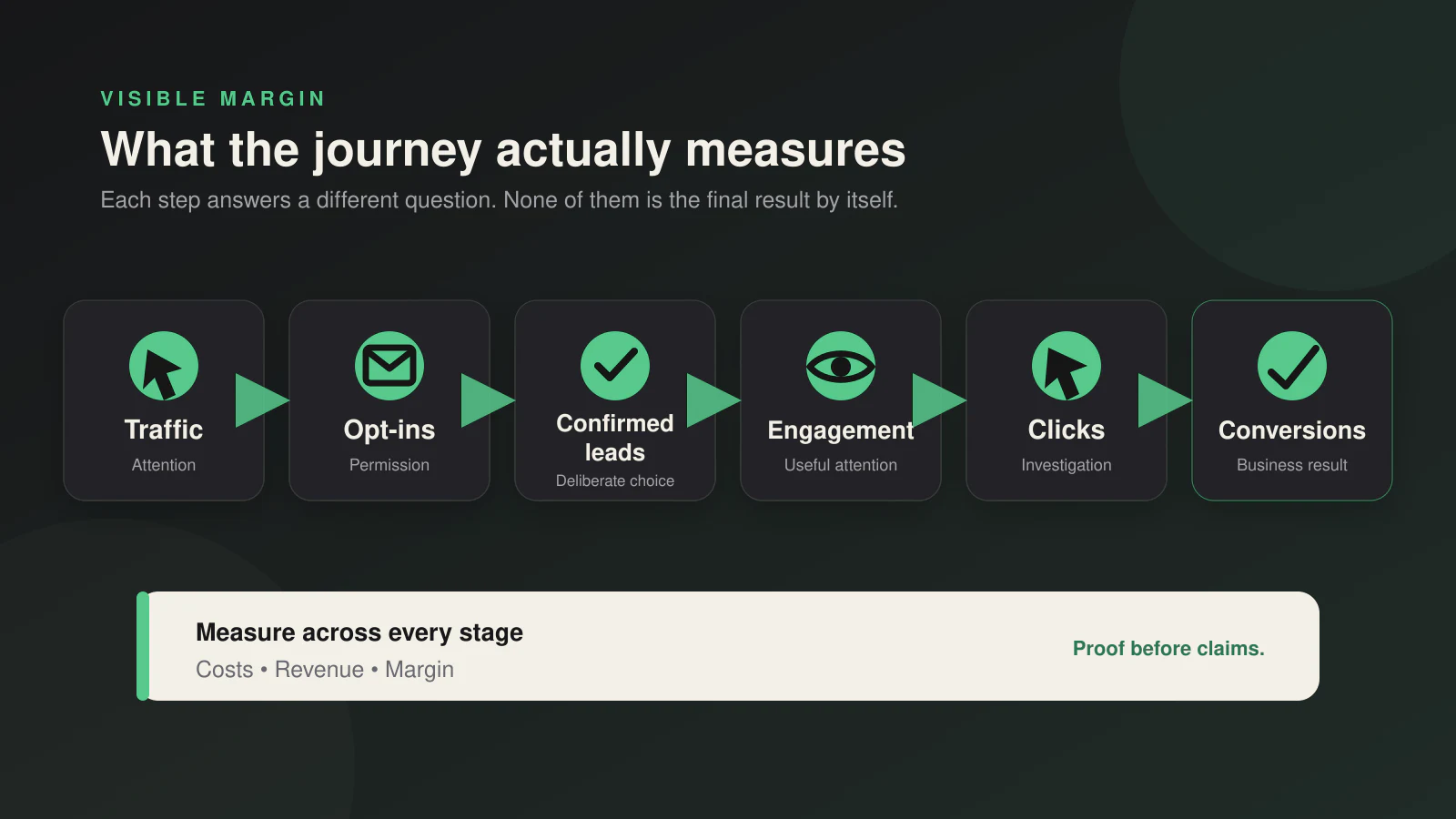
Each stage answers a different question.
- Traffic: Did the message create attention?
- Opt-ins: Did the landing experience make the next step clear?
- Confirmed leads: Did people actively choose to continue?
- Engagement: Did they open, read or interact with the useful material?
- Clicks: Did the next step feel relevant enough to investigate?
- Conversions: Did any of that activity become a measurable business result?
Costs, revenue and margin sit across the entire chain. They cannot be added only at the end.
Different traffic sources will also be tracked separately where possible. Paid or third-party leads should not be labelled organic. A confirmed lead from one source should not automatically be assumed to have the same intent or value as a confirmed lead from another.
What we know — and what we do not
Inbox to Payday already has active traffic. Its double opt-in flow and first email have been tested end to end.
That proves the mechanism works.
It does not yet prove that the funnel is profitable, that every traffic source is high quality or that the downstream opportunity is right for every reader.
Those conclusions require real numbers over time.
This is also separate from Experiment 001 — Invincible Marketer × Wealthy Affiliate. Traffic and results from the Inbox to Payday track will not be mixed into that experiment. Different systems need separate attribution if the conclusions are going to mean anything.
The point of documenting the journey
A funnel can be technically functional and still fail economically.
It can produce clicks but few confirmations. It can produce confirmed leads but little engagement. It can generate sales while acquisition and operating costs erase the margin.
Looking at the whole journey makes those failures visible.
It also creates a better experience for the person moving through it. The reader gets context before a pitch, clear expectations and a chance to evaluate the decision rather than being pushed directly from curiosity to a purchase page.
That is the standard this track will be measured against.
If the numbers remain weak, the next step is not automatically to quit or persist. Use a fair-test decision framework to identify whether the failure is reach, message, page, offer or economics.
What comes next: As enough attributable data is collected, Visible Margin will report confirmation, engagement and conversion stages separately. Inbox to Payday results will not be blended into Experiment 001.
Want to see the framework first?
Inbox to Payday is a free beginner guide to building a simple online income system around attention, email and a relevant offer.
Free beginner guide See the Inbox to Payday framework Start with Attention → Email → Offer, then evaluate the next step for yourself. Get the guide →The guide and follow-up may introduce tools, systems or opportunities. Relevant affiliate relationships will be disclosed. Earnings are not guaranteed, and it is possible to earn nothing or lose money.
What part of the journey do you think online business marketers explain least clearly? Comments are open, and useful questions may shape a future Insight.