DECISIONS BEFORE DIRECTIONS.
Before You Quit Another Online Business System, Ask These 3 Questions
If you are wondering when to quit an online business, the answer is not simply “never quit” or “move on quickly.” The harder question is whether you have collected enough evidence to know what actually failed. Changing direction too early can erase useful learning. Persisting without limits can turn a weak idea into an expensive habit.
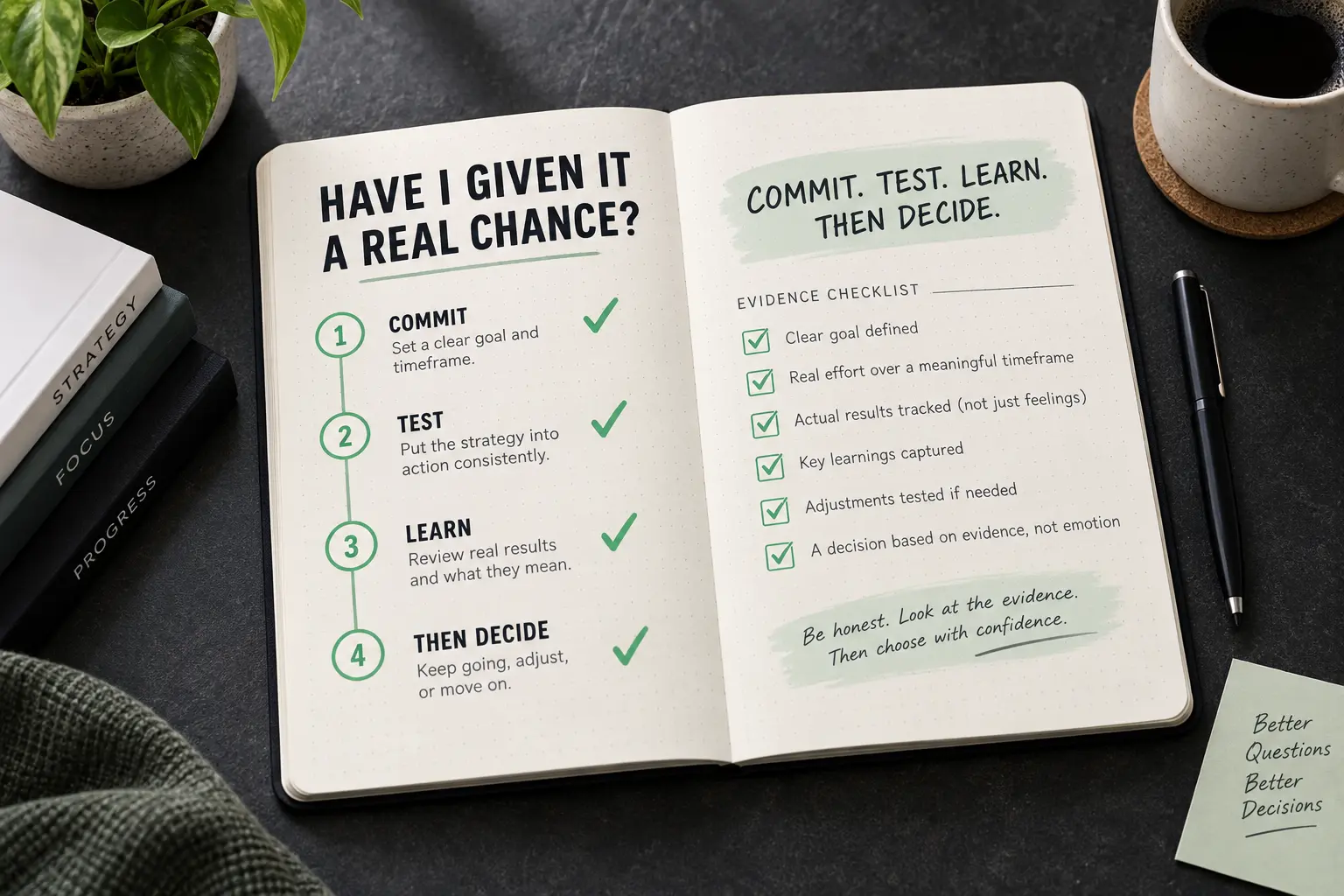
A better decision starts with three questions: Do I care enough about the work to keep learning? Did I stay consistent after the novelty disappeared? And have I tested the system long enough—with stable variables and meaningful data—to judge it fairly?
The real danger isn’t quitting. It’s never knowing why.
Program hopping feels productive because every new system restores possibility. New training, a new funnel or a new traffic method can create a burst of energy. But if you switch before the first approach produces interpretable evidence, you do not learn whether the problem was the model, the message, the audience, the execution or simply the sample size.
The opposite mistake is blind persistence. “Never quit” is poor advice without a defined hypothesis, budget, time commitment and stopping rule. Commitment is useful only while the next investment still makes sense.
Research on the sunk-cost effect found that people become more likely to continue an endeavour after investing money, effort or time. Cognitive effort can deepen the attachment too: once you have learned a platform, built pages and defended your choice, leaving can feel like admitting that all of it was wasted. It was not necessarily wasted if it produced transferable skills or better evidence. But it should not control the next decision.
Question 1: Am I interested enough to keep learning?
Many people are attracted to an outcome—more income, flexibility or independence—without liking the recurring work needed to produce it. That distinction matters. A content-led business requires research, creation and distribution. Affiliate marketing still requires audience understanding, useful communication and follow-up. Software does not remove those jobs.
You do not need to enjoy every task. You do need enough interest to improve at the work that repeats. Ask whether you are willing to learn the model, not merely whether you want its advertised result.
Business-model fit also includes budget, time, beginner suitability, ownership and structural risk. The Visible Margin scoring framework separates those factors so that enthusiasm is not mistaken for fit.
Question 2: Did I stay consistent after it stopped being exciting?
Novelty makes activity easy. Evidence usually arrives during repetition: publishing again, improving the same message, following up and recording the result. If you change the offer, audience, channel, creative and landing page at the same time, even a better result cannot tell you which change caused it.
Stable testing does not mean repeating an ineffective action forever. It means holding enough variables steady to learn something. Define the audience, offer, traffic source and primary message. Change one important variable at a time. Record the date, input and outcome.
This is the logic behind the Visible Margin experiments: wins, losses and inconclusive results all count, but only when the test is clear enough to interpret.
Question 3: Have I tested it long enough to judge it fairly?
There is no universal number of days. A high-volume offer may generate a useful sample quickly. An organic content strategy may need longer because discovery compounds slowly. Time alone is not the threshold; evidence is.
Before deciding that an online business is not working, define the minimum activity and sample you need. How many relevant people saw the message? How many clicked with genuine intent? Did the page collect leads? Did customers buy and remain? What did it cost, and how many hours did it require?
| Diagnostic question | Evidence to track |
|---|---|
| Did people see it? | Reach / impressions |
| Did the message resonate? | Engagement / saves |
| Did people show intent? | Qualified clicks |
| Did the page work? | Leads / opt-in rate |
| Did the offer convert? | Customers / sales |
| Did the economics work? | Revenue − attributable costs |
| Was workload reasonable? | Hours worked |
| Did customers remain? | Retention |
A sale is the end of a chain, not the only useful signal. The Journey From Click to Opportunity shows how traffic, clicks, confirmed leads and conversions diagnose different parts of the system.
But don’t turn “give it a chance” into an excuse to keep losing
A sunk cost is a past cost that cannot be recovered. It may explain how you reached today, but it does not make the next investment worthwhile. The rational comparison is between the likely future value of continuing and the future cost of doing so.
Don’t ask:
“I’ve already spent $500. Shouldn’t I keep going?”Ask:
“Knowing what I know today, is the next $100 and the next ten hours still a sensible test?”
This framing protects you from two biases at once: abandoning a useful system because it feels slow, and defending a weak system because you have already paid for it.
Five reasons to seriously consider stopping
- The economics no longer make sense. Plausible conversion and retention cannot cover the next round of costs.
- The marketing requires claims you cannot responsibly defend. A business is not a fit if selling it depends on exaggeration, concealed risk or unsupported earnings language.
- You fundamentally dislike the recurring work. Temporary frustration is normal. Persistent dislike of the model’s core activity is a fit problem.
- Structural or platform risk becomes unacceptable. Rule changes, account dependence, payment restrictions or weak ownership may change the original decision.
- A properly defined test rejected the hypothesis. Enough relevant traffic, stable execution and measurable outcomes produced evidence that the idea or route is unlikely to work within your limits.
A simple decision framework before you switch again
State the hypothesis, inputs, time range and success threshold you actually set.
Record activity and outcomes without rewriting the goal after seeing the result.
Separate an audience, message, page, offer, economics or workload problem.
Name the evidence or single change that makes the next investment rational.
If you are still assembling the basic workflow, How to Start an Online Business explains how to build a simpler, measurable structure without treating more tools as progress.
People Also Ask: Quitting, Pivoting and Giving an Online Business a Fair Chance
These answers reflect closely related current search intent. They are not presented as verbatim Google People Also Ask questions unless independently verified.
How do you know when it’s time to quit a business?
Consider quitting when a defined test has produced enough evidence that the economics, recurring work, ethical requirements or structural risk no longer fit your limits—and when a realistic next test is not worth its future cost.
How long should you give a business before giving up?
Long enough to reach a pre-defined evidence threshold, not an arbitrary calendar date. Set a minimum sample for relevant reach, qualified clicks, leads or sales, plus a maximum budget and workload. Slow organic strategies may require more time than high-volume tests.
Should you quit a business that isn’t making money?
Not automatically. First identify whether the failure is reach, message, landing page, offer, follow-up or economics. Continue only when the next test is affordable, specific and capable of resolving a genuine uncertainty.
When should you pivot instead of quit?
Pivot when evidence supports the underlying audience problem but rejects one part of the solution—such as the message, channel, offer or delivery method. Quit when the core hypothesis or acceptable economics have been rejected.
How do you know whether to keep going or move on?
Compare the expected value of the next bounded test with its cost in money and time. Keep going when evidence is improving and the next test answers a clear question. Move on when you are repeating activity without learning or when the downside exceeds your limit.
Why I’m applying this rule to the next system I’m testing
I have recently started evaluating another integrated online-business system. I am interested in whether bringing training, funnels, follow-up, traffic guidance and tools into a more connected workflow actually reduces complexity.
Simpler does not automatically mean better. Joining it does not prove that it works. I am applying the same standard: use it, measure it, give it enough opportunity to produce evidence, then decide.
Run a better test
You do not have to choose between quitting too early and blindly persisting. Run a better test.
The goal is not loyalty to a program. The goal is becoming better at deciding what deserves more time, money and attention. Define what you expect, hold the important variables steady, measure the complete journey and decide from the next cost—not the old one.